Gender Affirming Care Testimonies
Testimonies are from HRW's "They're Runining People's Lives: Bans on Gender-Affirming Care for Transgender Youth in the US" report unless otherwise indicated.
Meet Kai and Kimberly Shippley
Trans In America: Texas Strong is an intimate portrait of Kimberly and Kai Shappley, a mother who has to confront her religious community while her 7-year-old transgender daughter navigates life at school— where she’s been banned from the girls’ bathroom in 2018. (Click to watch, 18:03)
In this 2022 VOGUE USA Short Documentary, "This Girl's Life: On Growing", Kai Shappley is an advocate, an aspiring author, and a Dolly Parton–adoring actor; she is also an 11-year-old in the eye of a political storm. (Click to watch, 11:22)
Meet Luca (16), Sophie (32) and Nora (69) in Germany
This DW Documentary follows the story of three Trans activists from three generations who fight for recognition in Germany in 2024. (Click to watch, 25:55)
Meet Jack, 16-years-old
Jack, a 16-year-old transmasculine person living in a state with a ban in effect, described dysphoria as: “[When] the inside of you doesn't match your outside... it’s almost like you want to crawl out of your skin. You're so uncomfortable that you don't want to be in your body.”
Meet Kai, 14-years-old
For some, the pain of dysphoria can be severe. Kai, a 14-year-old trans boy in a state with a ban in effect, said, "I've had suicidal ideation almost all of my life. I remember even as a 5-year-old having feelings of worthlessness and [thinking] why am I even alive? And more so to the point of having bad gender dysphoria, I don't even recognize the person I see in the mirror. Why should I even live this life that isn't mine? And with the ramping up of anti-trans legislation… I felt more suicidal."
Many individuals who experience gender dysphoria may socially isolate, avoid mirrors or photographs, or develop disordered eating habits. Even routine functions can become challenging. As Kai explained, “I got a lot of bottom dysphoria from using the bathroom for a really long time.”
“It felt like I wasn't allowed to have puberty and be happy and just be a regular child. I had to feel horrible and depressed and suicidal because it isn't who I am–to be in a woman's body, to be going through a female puberty—because I'm not a girl.”
Meet Mylie, 17-years-old
The ban on gender-affirming care, as well as other state laws targeting trans youth, caused Mylie’s mental health to decline. As she recalled, "The fear of losing the thing that's making you yourself and that's allowing you to express yourself to the community is a very scary feeling. And my mental health had severely dropped during that time. I was constantly worrying about if I had to move away or just leave everything behind in the fear that this law would pass. I had become less social. I had not been doing my schoolwork. I didn't want to go out of my room. I didn't eat as much, I didn't do it. It was basically a loss of everything, motivation.... It had been making me fear that I've only had so much time left to show my true self before it was completely taken away."
In response to the state ban on gender-affirming care, Mylie attempted suicide twice. As her mother, Sarah, explained, “there were times of me having to sit in the hallway of her bedroom, not wanting to leave her alone, like her being on the bathroom floor and crying. This is stuff that we never had before.”
Mylie was eventually able to establish care with a physician in a neighboring state who provided gender-affirming treatment. Sarah travels to the same neighboring state to pick up Mylie’s prescriptions. Whereas before the ban the family’s insurance was able to process the medications, now the medications must be paid for out of pocket. If submitted through insurance, the claim is automatically rejected based on their family’s zip code given the state law.
Meet Evan, parent
"The rhetoric in these legislative sessions suggests you just walk in and they're handing you hormones and blockers… None of that happened. In the first year or more, not one prescription was written. They [doctors] said, 'We're here to listen to you and react based off of what you thing your need are.' Which was incredible as a parent, right? It puts you at ease… It's a slow, methodical process."
– Evan, father of a 17-year-old trans girl in a state with a ban in place, March 22, 2024
Meet Sarah, parent
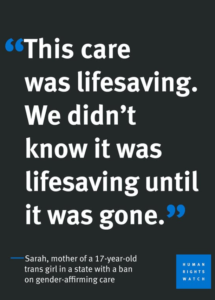
"For her to come out as a young child and have that kind of atmosphere where she'd be supported, she was given the opportunity to have the blockers so her body did not go further into a transition into a body that she does not identify with… her voice never dropped… and [she was] able to go to the bathroom and own it. This is my bathroom. I'm a girl. All those things immediately reduced the anxiety."
The family’s life changed when their home state passed a ban on gender-affirming care which included an “aiding and abetting” clause penalizing physicians who facilitated care. Without notification, the pediatric endocrinologist they had been seeing throughout Mylie’s adolescence abruptly ceased offering gender-affirming services when the law was passed, but before it took effect. Mylie recounted that the doctor “completely vanished off the face of this planet for three weeks and no one knew where he went.”
After weeks of silence, their doctor resurfaced but did not offer referrals or sent medical records. As Sarah recalled, "He was not willing to refer anybody to the doctor [in a nearby state without a ban] because he was told that would be considered facilitating care. So, what he would do is he would write on a piece of paper the name of the doctor and slide it across, not say anything out loud, just slide it across, and it was up to the patient to decide what they did with that. When he felt that became too risky, he started to write the name of [a local LGBT center] on this paper and slid it across, and then it became on [that organization] to get them referred to the physician in [a nearby state without a ban] so that there would be no further facilitation of care."
Meet Grace, parent
Before starting gender-affirming care, Grace's 18-year-old son would cry at his own reflection in the mirror, Grace said. She recalled the impact of gender-affirming care: “Shortly after [he started] testosterone, I walked by and he was in the bathroom grinning, grinning at himself [in the mirror] like an idiot. And I'm like, ‘What are you doing?’ And he said, ‘I finally feel like myself.’”
Meet Rachel, parent
Rachel believes that anti-trans legislative and rhetorical climate triggered her daughter's mental health crisis.
"It was just the message that if you're trans… that's a lie and you need to go to church and you don't need that medicine.... And I just can remember hearing that message over and over, and I would turn the TV off or whatever, but I just remember one day having a really bad day, and we were going through a lot of emotions, and I just wanted to break my television. I mean, I was just like, what in the hell?... So yeah, the politicians really… for lack of a better word, infuriate me."
Rachel found someone online in her hometown who provided the necessary medication to bridge the gap until her daughter could receive proper care at the clinic.
"It's crazy—I felt like I was trying to get illicit drugs. This really sweet trans woman reached out and said, 'Please don't tell anyone, but I have this.' I checked with my doctor, and he confirmed it was safe. It was sad because she [the woman she met online] was so scared I might turn her in. I remember when I met her to get the meds, we hugged. She’s in her late forties, transitioned later in life, and shared how she never had a loving, accepting parent."
Meet Amelia, parent
Amelia, the parent of a 10-year-old trans girl, Natalia, described the challenges her family faced while seeking gender-affirming care in their home state.
After extensive searching, they found a clinic in another region, but accessing it required air travel. Each trip costs the family approximately $800-$900 in travel expenses alone.
Amelia is concerned about the impact of limited access to care on Natalia's well-being.
"I can't imagine forcing my child to go through development as a man and then have to reverse it later. To her, it would be agony. I mean, she's so nervous that she's going to get facial hair. She's like, “I really just don't want to have facial hair. When is that going to happen? I don't want to look like a boy.” And just the thought of making her go through that really is very distressing for her, as distressing as it is for me when there is a treatment out there that could help her develop the way that she wants to be seen, in the way that she feels inside. So I hope that we'll be able to access the treatment that she needs if that's what she chooses."
Meet Hannah, parent
Hannah’s 10-year-old trans daughter, Lily, was approaching puberty as their state legislature passed several anti-trans laws, including a care ban. The family relocated across the country to a state without a ban in place to ensure their daughter could access age-appropriate medical care and grow up in a supportive environment.
Hannah described the decision to move: “That was really hard for us. My husband had lived there his whole life.... His mom is getting older, and she had moved closer to us specifically so we could help her. And so there was a lot of anxiety about what is going to happen with her, who's going to help her.”
She added: “We had been involved in that community for over 20 years… and had put a lot of work into making it our space and put a lot of work into having a community for our family.”
They chose not to tell Lily the real reason for their move, not wanting to burden her with that responsibility.
Meet Carol, organzier
We are a part of every single part of this country, and we have been during this entire time showing that we are professionals, we are caregivers. We've proved our humanity and it's very clear to us that that's not enough.
— Carol, trans organizer in a state with a ban in place, September 6, 2024
Meet Logan, trans advocate
Imagine you wake up tomorrow and everything about you is the same, your personality, your values, what you like, your hobbies, everything is the same except you're now the opposite sex.... How that would feel and how you'd have to face your family, your friends, your spouse, and try and stand in your conviction that you are who you are.
— Logan, a trans advocate in a state with a ban in effect
Meet Ethan, LGBT healthcare advocate
Ethan, an LGBT healthcare advocate working in a state with a ban in place, highlighted an insurance coverage disparity: while puberty blockers are routinely covered for conditions like precocious puberty, insurers often deny coverage when the same medications are prescribed to treat gender dysphoria. He said:
"It's hard to overstate the impact of not being able to access the care you need, not only because there's a difference between the care being banned and coverage being banned. For some of these folks, the fact that they are allowed to get it, they just can’t pay for it, is so demeaning and demoralizing and knowing that if the diagnosis code were anything else, anything other than gender dysphoria, it would be covered. And they would be afforded the same exact medical necessity analysis as everyone else, but solely because they're transgender, solely because the diagnosis is gender dysphoria, it’s categorically excluded."
Ethan said that out-of-state care presents additional insurance hurdles: “When people go out of state, their chances of coverage plummet. Their best hope is securing a network gap exception, which insurers rarely grant for gender-affirming care. This makes accessing necessary treatment virtually impossible.”
Meet Chloe, organizer
"Kids are extremely resilient, and they look at the stress that their parents are under. And a kid who is suffering with gender dysphoria might go, “I don't want to be this burden to my parents.” And they might self-select not getting hormone therapy or not getting puberty blockers and live through that misery because they don't want to put additional stress in their family for having to go out and get that care."
— Chloe, an organizer in a state with a ban, observed that some youth choose to endure severe dysphoria rather than burden their parents
Meet Olivia, provider in a state with a ban
"I felt it was critically important to invite pastoral care... and to my surprise, they jumped at the opportunity.... Our chaplain works closely with families, less so with the kids. Our young people don’t find faith to be a challenge, but parents often struggle.... We've had parents fired from their jobs for affirming their child.... Our chaplains help interpret scripture around love, affirmation, and life.
When you work with adolescents, they’re not separate from their families and communities.... We consult on youth in inpatient settings, emergency rooms, and psych units—those who have harmed themselves due to dysphoria and household conflict. Often, these interventions are an eye-opener for parents, and we serve as a crucial bridge. We’re fortunate to follow some of these kids in the clinic afterward, and you can see light emerge from very dark places."
Read more in HRW's "They're Runining People's Lives: Bans on Gender-Affirming Care for Transgender Youth in the US" report.