
Gender Affirming Care Toolkit

Lily, a 10-year-old trans girl, said she was devastated when her family felt forced to relocate to protect her from anti-trans hostility. Illustration by Barrack Rima, Art directed by Studio Safar for Human Rights Watch
In recent years, the United States has seen a rise in state-level legislation targeting the rights of transgender individuals, particularly transgender youth. Many of these efforts have focused on limiting access to gender-affirming care, a set of often critical social, medical, and psychological interventions that help transgender individuals align their physical bodies with their gender identity.
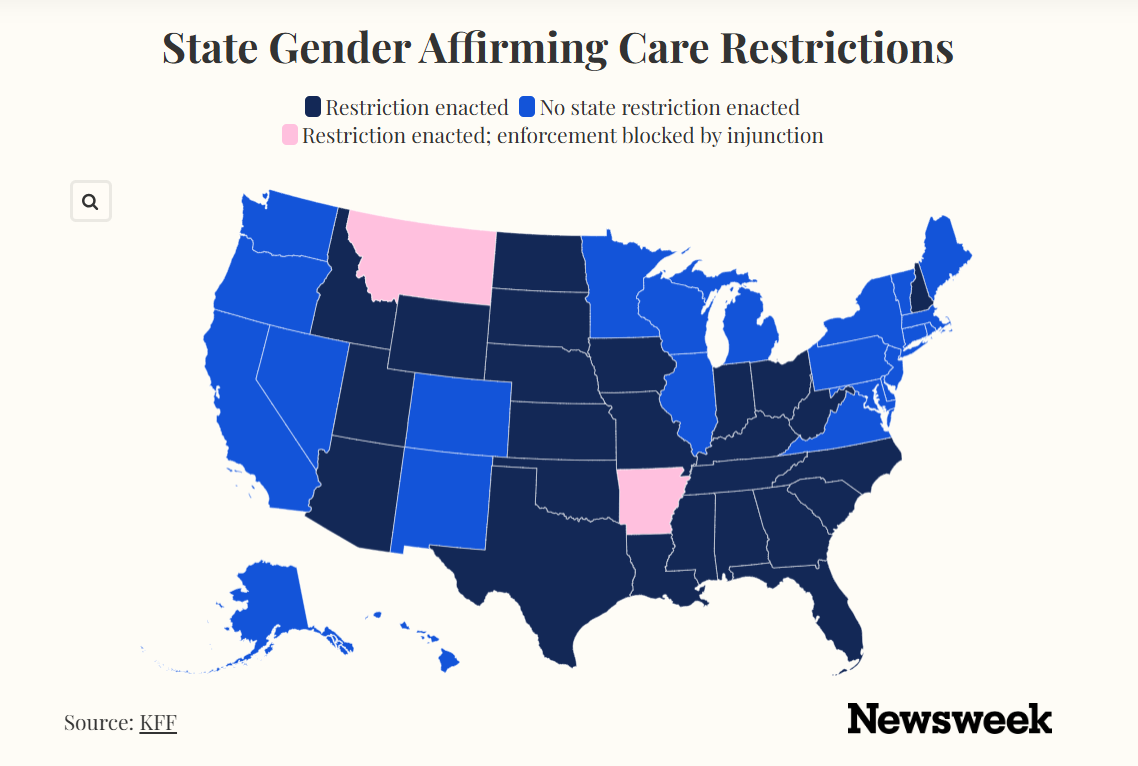
Since 2021, a wave of legislation targeting transgender health care has swept across the United States, with 25 states enacting blanket bans on gender-affirming care for transgender youth as of March 2025. These legislative bans, often vague and sweeping in scope, have disrupted healthcare access for over 100,000 transgender youth, and imposed significant geographic, financial, and emotional burdens on their families. (HRW)
Click on each tab for information and resources:
Gender Affirming Care Fast Facts
All facts come from HRW's "They're Runining People's Lives: Bans on Gender-Affirming Care for Transgender Youth in the US" report.
- Most of the youth who receive gender-affirming care continue this care into adulthood, with a continuation rate of approximately 98%.
- The reported mental health toll of these bans on transgender youth is particularly severe. A 2024 Trevor Project study found that suicide attempt rates among transgender youth increased by as much as 72% in the first year after the adoption of state-level anti-transgender laws.
- Families and advocates reported that insurance companies routinely deny coverage for out-of-state treatment, forcing families to bear significant financial burdens. Some families reported facing costs of up to $4,500 every six months for medications alone. These challenges disproportionately impact low-income families and rural residents, who often lack the resources to afford regular interstate travel for care.
- According to a 2024 study by the Centers for Disease Control and Prevention:
- An estimated 875,000 high school students in the United States identify as transgender or are questioning their gender identity.
- Approximately 26% of transgender students reported attempting suicide in the past year, compared with 11% of cisgender female students and 5% of cisgender male students. These figures arise as US youth are reporting high rates of depression, anxiety, and suicidal ideation more broadly; however, transgender youth remain at significantly higher risk.
- Six states classify the provision of gender-affirming care as a felony offense. Eight states have vague “aiding and abetting” provisions that restrict providers from facilitating gender-affirming care, which could include offering referrals or medical records, discussing out-of-state treatment options, refilling prescriptions, or even running lab tests.
- Since 2022, clinics and hospitals have reported bomb threats, arson attempts, and coordinated harassment campaigns. Providers have reported receiving death threats, having their personal information exposed online, and being forced to implement costly security measures. This climate of fear has driven many providers to cease offering care or relocate to states with more supportive policies, further reducing access to gender-affirming care for transgender individuals.
Educational Resources




The cascading effects of these legislative bans on transgender youth, their families, and the broader healthcare system require urgent intervention. Less than half of US states have enacted comprehensive statutory protections against discrimination based on sexual orientation and gender identity. The United States lacks comprehensive federal legislation explicitly protecting LGBT people from discrimination in areas such as education, housing, public accommodations, and federally funded programs.
To combat these challenges, STFers will:
On Campus Advocacy
- Review school and district policies related to students preferred name and pronouns, uniforms, locker rooms and bathroom use, etc. to see where attention is needed
- Work with campus curriculum teams to identify where LGBTQIA+ friendly lessons already exist, and where they can be embedded. Some initial entry points can include LGBT history and literature, sex education, gender identity in health classes, etc
- Interview students to share their experiences and highlight them in on-campus media or with the STF Team
- Escalate your advocacy to your school board where appropriate!
Local/Community Advocacy
With Elected City/County Officials:
- Participate in existing events that honor Trans Day of Remembrance (Nov. 20) and Trans Day of Visibility (March 31)
- If your city does not currently honor these dates, ask your elected officials to officially acknowledge them with an annual proclamation
With local LGBT Centers, develop/update:
- Purple books with resources for local and traveling families in need of LGBTQIA+ friendly resources in your area
- Landing guide for sanctuary states (see NY LGBT Network for an example of possible resources to develop)
Take Action: If You Only Have...
60 Seconds
- Bookmark this toolkit for quick access
- Create google alerts for "gender affirming care" and "trans rights" to stay current on this action plan
5 Minutes
- Read this glossary of important vocabulary related to gender affirming care
- Investigate your school’s website to see what resources are available to support and/or assist students who are transitioning
30 Minutes
- Read HRW's "They're Runining People's Lives: Bans on Gender-Affirming Care for Transgender Youth in the US" report
- Set up a conversation with your campus' Gay-Straight Alliance or other on-campus LGBT-friendly groups

Event Ideas
Every STF Action Plan comes with advocacy goals. One way to engage your campus community in these advocacy goals is to host on-campus events. Get started with the STF Event Planning Toolkit today!
Events and advocacy should be done throughout the year, but remember, November 20 is the Trans Day of Remembrance and March 31 is Trans Day of Visibility so let's aim to have every school working on this theme host an event around these dates!
Possible events to advocate for Gender Affirming Care include:
- Put together an artistic exhibit that highlights the experiences of trans youth, including photo, written and video testimonies
- Do classroom presentations explaining the realities of being a trans youth in the US at this moment, and the barriers they face at the school, state and federal levels. You can do this as general education or along side a documentary screening
- Give a faculty presentation about the importance of supporting LGBTQIA+ members of your community and find where LGBTQIA+ friendly lessons already exist, and where they can be embedded
- Interview students in your community who are willing to speak up on behalf of trans youth and post them on social media, include clips in morning announcements or on your campus TV news, send to the STF Team to be shared across the program, etc.
- Collaborate with other clubs on campus to host a chalk event, create an artistic display on campus or get everyone to wear light blue, pink and/or white (colors of the trans flag) on the same day
- Draft/update your SBRR to ensure LGBTQIA+ students and staff are protected when on campus
- Check out STF's Event and Advocacy Ideas list for additional ideas!
In every report, Human Rights Watch makes recommendations for how to improve the human rights concerns addressed. These are just some of the recommendations HRW has made to improve the quality of life for youth seeking gender affirming care in the United States in the "They're Runining People's Lives: Bans on Gender-Affirming Care for Transgender Youth in the US" report.
While the below recommendations are specific to the United States, they can be adapted for anywhere in the world.
To State Legislatures
- Lift barriers to medically prescribed gender-affirming care in line with best practice standards for transgender health established by WPATH, the Endocrine Society, and other leading medical professional organizations across multiple specialties.
- Repeal existing bans on gender-affirming care and reject proposed laws and policies that would restrict access to such care.
- Enact legislation protecting access to gender-affirming care and prohibiting discrimination against transgender youth and their families.
- Ensure state Medicaid programs cover gender-affirming care.
- Enact comprehensive shield laws to protect access to gender-affirming care by:
- Protecting providers and families against out-of-state investigations and prosecutions.
- Requiring insurers to maintain coverage and preventing discriminatory rate increases for providers of gender-affirming care.
- Safeguarding medical records and the personal information of patients, providers, and facilities providing gender-affirming care.
- Establish mechanisms to assist out-of-state families relocating in search of safer communities and access to gender-affirming care for transgender youth.
To State Attorneys General
- Issue guidance protecting providers who offer gender-affirming care to the extent possible under state law.
- Join multi-state efforts to challenge restrictions on gender-affirming care.
- Enforce existing non-discrimination protections that protect transgender individuals’ access to health care.
- Investigate discrimination against transgender individuals in healthcare settings, including cases in which medical facilities preemptively discontinue gender-affirming services despite no legal requirement to do so.
- Exercise prosecutorial discretion to decline to enforce restrictions on gender-affirming care that conflict with medical best practices.
To State Medical Boards
- Develop clear guidelines for providers offering gender-affirming care that align with established medical standards.
- Protect medical professionals' licenses from out-of-state actions related to providing gender-affirming care.
- Provide resources and training to healthcare providers on best practice gender-affirming care standards and practices.
- Issue statements supporting best practice gender-affirming care when medically indicated.
To the US Congress
- Reject attempts to ban gender-affirming care nationwide.
- Retain legislative frameworks that prohibit sex discrimination in healthcare settings, and expressly codify protections against discrimination based on gender identity.
- Allocate federal funding for scientifically based non-partisan research on gender-affirming care outcomes and best practices.
- Ensure federal health programs cover the costs of gender-affirming care on the same basis as other forms of medically indicated care.
- Pass legislation preventing states from criminalizing interstate travel for medical care, including gender-affirming care.
To the Executive Branch
- Rescind executive orders that deny rights and recognition to transgender people and undermine access to gender-affirming care.
- Restore previous guidance recognizing gender identity discrimination as a form of sex discrimination within the executive branch and ensuring federal civil rights protections are enforced to protect transgender individuals.
 Sophia, an 18-year-old trans woman, said she was driven to attempt suicide, resulting in a week-long hospitalization, after she had been feeling attacked by anti-trans media and her state banned genderaffirming care.
Illustration by Barrack Rima, Art directed by Studio Safar for Human Rights Watch
Stay up to date on Human Rights Watch's LGBT Division's coverage about policies impacting LGBTQIA+ people around the world.
Report: They’re Ruining People’s Lives: Bans on Gender Affirming Care for Transgender Youth in the US
Human Rights Watch Country Profiles: Sexual Orientation and Gender Identity
Recent HRW News Articles:
- July 20, 2026: The America's Anti-Gender Playbook
- July 10, 2026: We're Having the Wrong Fight Over Youth Gender-Affirming Care
- June 26, 2026: Protecting Children Means Defending LGBT Rights
- June 19, 2026: The Collateral Damage of Anti-Trans Policymaking
- March 12, 2026: NHS England Blocks Access to Gender-Affirming Hormone Therapies
- March 3, 2026: US State Revokes Gender Affirming Identification
- December 3, 2025: Don’t Let Illinois Become a Stage for Repression
- September 9, 2025: Trump Moves to Restrict Gender-Affirming Care to Federal Workers, Families
- April 10, 2025: Instead of Addressing Child Abuse Prevention, Trump Attacks Trans Youth
- October 21, 2024: Texas Targets Doctor Over Gender-Affirming Care Ban
- May 22, 2024: An Urgent Call to Protect Gender-Affirming Care
- May 10, 2024: School Officials Should Protect Trans Youth, Not “Out” Them