Demanding Our Rights: The Convention on the Rights of the Child Toolkit
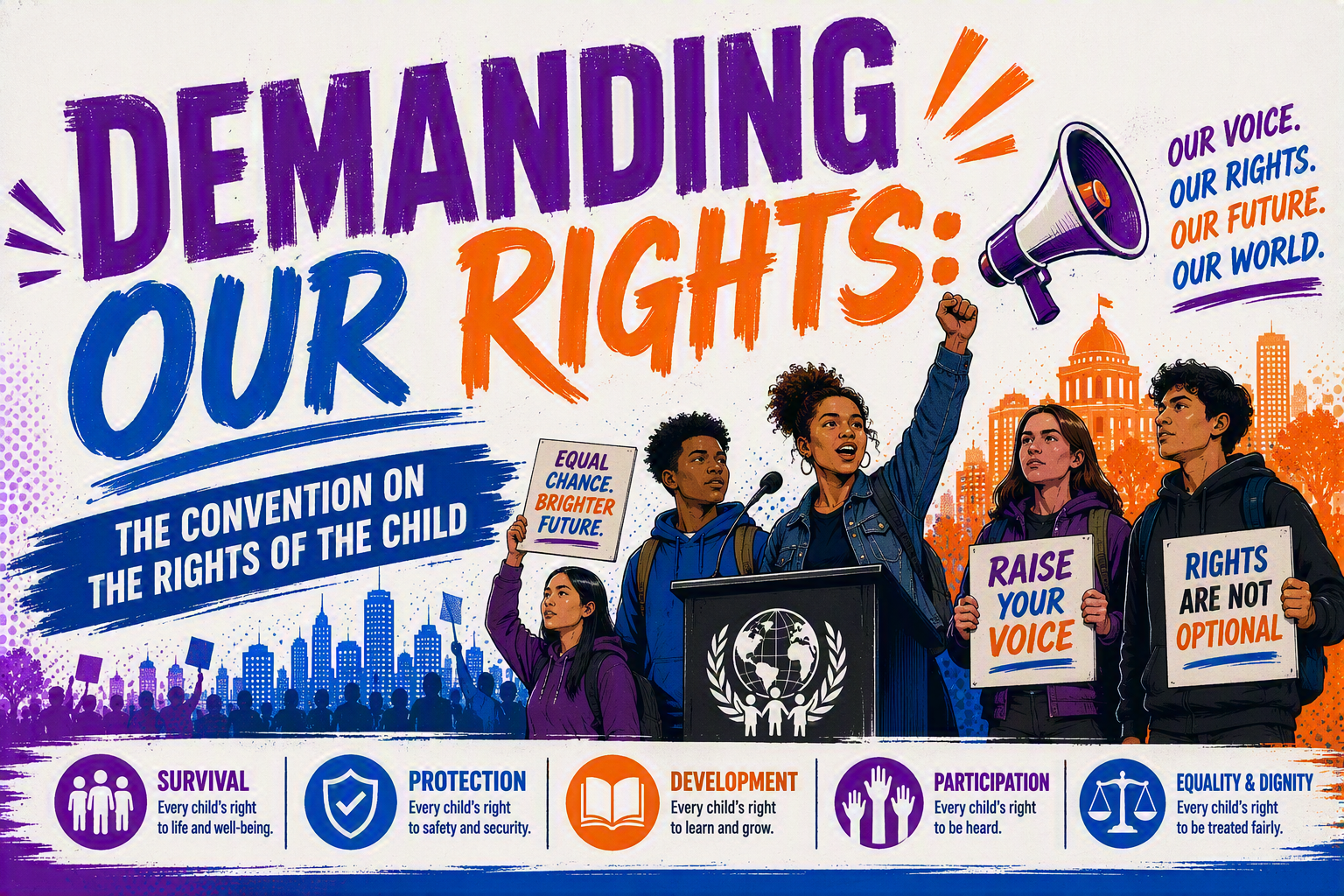
AI generated image
In 1989, world leaders made a historic commitment to the world’s children by adopting the United Nations Convention on the Rights of the Child (CRC) – an international agreement on childhood.
It’s become the most widely ratified human rights treaty in history and has helped transform children’s lives around the world.
But still not every child gets to enjoy a full childhood. Still, too many childhoods are cut short.
It is up to our generation to demand that leaders from government, business and communities fulfil their commitments and take action for child rights now, once and for all. They must commit to making sure every child, has every right. (UNICEF)
This year, STFers will:
- Get educated on the rights of children and how they are being upheld and violated around the world;
- Dive deep on issues directly impacting youth, including related to the right to education, immigration detention and gender affirming care; and
- Engage their classmates in advocacy that supports the human rights of people under the age of 18 at home and abroad.
Click on each tab for information and resources about each theme:
About this theme: Most of us probably say we know a lot about human rights, but struggle to define them and give examples. This theme will help build our foundation for human rights by doing a deep dive into the Convention on the Rights of the Child. As young human rights advocates, we need to think critically about the different ways our human rights can be impacted. Some violations are in our face obvious, while others, we may not know are even happening to us. Often, we recognize when someone else’s human rights are being violated, but do we know what to do when we see a violation? Or do we know when we’re experiencing a violation ourselves? Do we notice when our rights are being upheld? Do we take that for granted?
Advocacy Ask: STF members will find out where human rights are discussed within their communities and ensure their classmates have a foundational knowledge in their basic human rights, and more!
CRC Articles Impacted: All 54 articles!
About this theme: The United States operates the largest immigration detention system in the world. Over the last decade, the US immigration detention system has entered a new phase of unprecedented growth. In fiscal year 2025, the US detained more than 310,000 people in more than 200 detention centers, jails, and prisons across the country. As of February 2026, Immigration and Customs Enforcement (ICE) maintains an average daily population of 67,456 people in its detention network, which includes facilities overwhelmingly run by private contractors.
The ICE detention system has operated with a consistent lack of transparency across administrations. Incidents of violence, failures in medical treatment, and abusive conditions of confinement are similarly underreported. Since the second Trump administration took office in January 2025, at least 52 people have died in ICE custody, making 2025 the deadliest year on record for immigration detention, with 2026 currently on track to surpass that total. (HRW)
Advocacy Ask: STFers will collect petition signatures and demand their US federal representatives provide oversight of the immigration detention facilitaties in their state and uphold the human rights and dignity of every incarcerated individual.
CRC Articles Impacted: 2, 3, 5, 6, 8, 9, 10, 11, 13, 16, 18, 19, 20, 22, 24, 25, 27, 28, 29, 31, 36, 37, 39, 40
About this theme: People around the world face violence and inequality—and sometimes torture, even execution—because of who they love, how they look, or who they are. Sexual orientation and gender identity are integral aspects of our selves and should never lead to discrimination or abuse.
Since 2021, a wave of legislation targeting transgender health care has swept across the United States, with 25 states enacting blanket bans on gender-affirming care for transgender youth as of March 2025. These legislative bans, often vague and sweeping in scope, have disrupted healthcare access for over 100,000 transgender youth, and imposed significant geographic, financial, and emotional burdens on their families. (HRW)
Advocacy Ask: STFers will ensure their local and state legislators are upholding the human rights of their LGBTQIA+ neighbors and identify supportive businesses and resources that can be shared with local and visiting families.
CRC Articles Impacted: 2, 3, 5, 6, 8, 12, 13, 16, 17, 40
About this theme: In the 2025-26 academic year, STF Chapters worked with administrators, teachers, students and parents to develop a Student Bill of Responsibilities and Rights (SBRR) that will help their schools become more human rights friendly. STFers are accomplishing this by:
- Building coalitions on campus to ensure all aspects of the school community are represented;
- Identifying which issues are of most concern to students and educators on campus; and
- Garnering support from school decision-makers to ensure that our schools uphold the human rights of our current and future classmates long after we graduate.
Advocacy Ask: Develop and implement an SBRR on each campus.
CRC Articles Impacted: 1, 2, 3, 4, 6, 7, 8, 12, 13, 14, 15, 16, 17, 23, 24, 26, 27, 28, 29, 31, 36, 41, 42
About this theme: Adequate housing is a human right. The United States is failing to protect this right for large numbers of people, with houselessness a pervasive problem. Since 2016, the unhoused population has increased every year. Over the course of 2023, nearly one million people experienced houselessness for the first time, the highest number ever recorded (National Alliance to End Homelessness).
Advocacy Ask: Continuing their advocacy from the last two years, STFers are identifying resources available for housing insecure students and teachers within their communities and developing strategies for ensuring all those in need of these resources have easy access to them. STFers are also advocating with local City Councils and Mayors to end criminalization and promote the passing of policies protecting the human rights of the unhoused.
CRC Artciles Impacted: 2, 3, 4, 6, 8, 9, 16, 17, 24, 25, 26, 27, 28, 29, 31, 32, 33, 34, 35, 36, 40, 41, 42